
Local SEO Checklist for Small Businesses in India (2026)
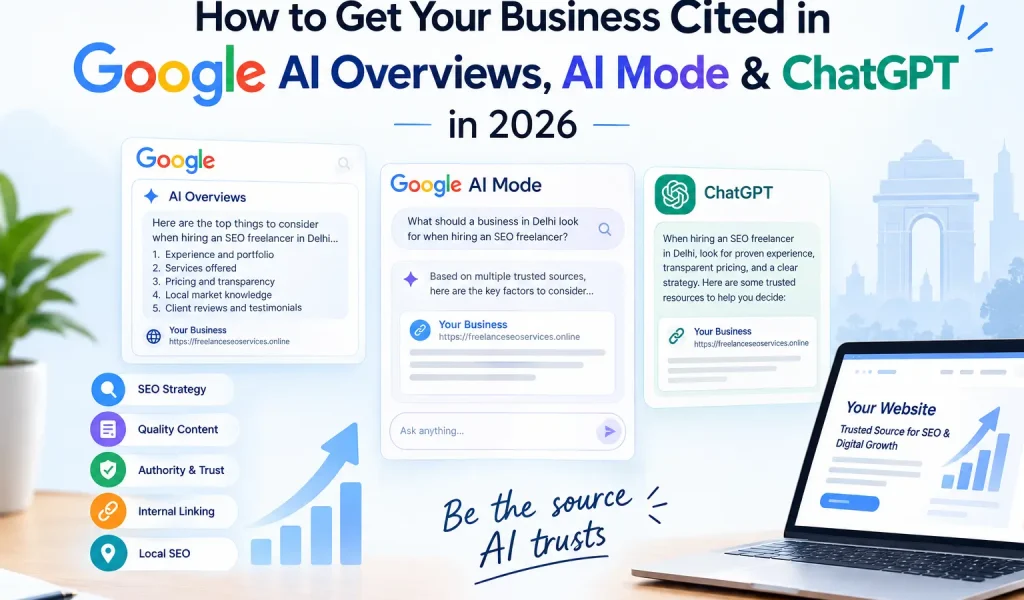
Search is changing.
People are no longer relying only on traditional Google results to find businesses, products, services, and answers. Google now provides AI-generated answers through AI Overviews and AI Mode, while users are increasingly turning to tools such as ChatGPT to research businesses and make decisions.
For businesses, this creates a new question:
How do you get your website and brand mentioned or cited when someone asks an AI search engine about your products, services, or industry?
The answer is not to abandon traditional SEO and chase a collection of so-called AI-search hacks.
Google’s current guidance makes this clear: the SEO fundamentals that help pages appear in traditional Google Search remain important for generative AI features too. Your pages need to be crawlable, indexable, useful, reliable, and easy for search systems to understand.
However, the way people discover information is changing, which means businesses should think beyond rankings alone.
This guide explains how to prepare your website for Google AI Overviews, Google AI Mode, and ChatGPT in 2026, including content strategy, technical SEO, internal linking, entity signals, brand authority, structured data, digital PR, and measurement.
Google AI Overviews are AI-generated summaries that can appear within Google Search for queries where an AI-generated response can help users understand a topic.
AI Mode takes the concept further. Instead of simply displaying a traditional results page, it allows users to ask more complex questions and continue exploring the topic through follow-up questions.
For example, instead of searching:
“best SEO freelancer in Delhi”
a user could ask:
“What should a small business in Delhi look for when hiring an SEO freelancer, and what services should be included?”
AI-powered search can break complex questions into related subtopics and retrieve information from multiple sources before generating a response.
That creates a different visibility opportunity for businesses.
Your website does not necessarily need to be the traditional number-one result for every query to become a useful supporting source. Your content needs to be relevant to the question, accessible to search engines, and strong enough to be considered a useful source.
ChatGPT can also search the web and provide users with links to websites that support its answers.
For publishers, OpenAI states that public websites can appear in ChatGPT search. Websites that want their content to be discovered and cited should ensure that they are not blocking OAI-SearchBot from crawling relevant pages.
This means technical accessibility matters beyond Google.
If your website is blocked from being crawled, search systems may have difficulty discovering and using your content.
Before thinking about advanced AI-search strategies, make sure your website can actually be discovered.
Yes.
This is one of the biggest misconceptions surrounding AI search.
You do not need to replace SEO with GEO or AEO.
Google’s current documentation says that its generative AI search features are built on its existing Search systems. Google also says there are no additional technical requirements or special optimizations required specifically for AI Overviews and AI Mode.
That means the fundamentals still matter:
AI search changes the search experience, but it does not make good SEO obsolete.
In fact, a technically weak website with thin content is unlikely to become a strong AI-search source simply because the business adds a few FAQs or creates an llms.txt file.
The first step toward AI-search visibility is surprisingly simple:
Answer real questions better than the alternatives.
AI systems need information they can use to construct an answer.
Consider a business selling accounting services.
A weak page might say:
“We provide professional accounting services with experienced professionals.”
A stronger page could explain:
The second page provides substantially more useful information.
It also creates more opportunities for the page to match different questions.
This is particularly important because modern search systems can understand related concepts and queries rather than requiring an exact keyword match.
AI-friendly content does not mean writing content for robots.
It means making information easy for humans and machines to understand.
For important questions, give the answer early.
For example:
SEO does not have a universal timeline. Less competitive local searches can show movement within a few months, while competitive national keywords can take substantially longer. Results depend on the website’s existing authority, technical condition, competition, content quality, search intent, and the amount of work being implemented.
Then explain the details.
This structure works because a reader can immediately understand the answer while the rest of the section provides supporting context.
Use:
Do not turn every paragraph into a three-sentence “AI answer.”
Write naturally for people.
One article rarely establishes strong topical authority.
If your business provides SEO services, for example, you should build a connected content ecosystem around SEO.
Your website could cover:
These pages should not exist as isolated articles.
Connect them.
Your main SEO Services in India page can act as a commercial pillar, while supporting articles answer specific informational questions.
For example:
SEO Services in India → AI Search article → Technical SEO → SEO Audit → Local SEO → City service page
This creates a logical information architecture.
Internal linking is particularly important when you are building a topic cluster.
Do not add twenty internal links just because you can.
Instead, link when another page genuinely helps the reader.
For example, if you explain that technical problems can prevent search engines from properly accessing a website, link to your detailed Technical SEO Services page.
If you discuss hiring an SEO professional in Delhi, link to your SEO Freelancer in Delhi page.
If you discuss the broader SEO process, link to your SEO Services in India page.
Good internal anchors could include:
Avoid creating a paragraph that looks like this:
SEO freelancer in Delhi, SEO expert Delhi, SEO services Delhi, best SEO freelancer Delhi, SEO consultant Delhi…
That is not useful to readers and makes the content look artificially optimized.
AI systems need to understand not only what your website says, but also who is saying it.
If you are a consultant or freelancer, make your identity clear.
Your website should consistently communicate:
For example:
Muzaffar Ali is a freelance SEO professional based in Delhi, India, providing technical SEO, on-page SEO, local SEO, content strategy, and search optimization services for businesses in India and international markets.
Then support those statements throughout the website.
Your About page, homepage, service pages, author information, and external profiles should not contradict one another.
Consistency helps establish a clearer entity.
One of the easiest ways to make SEO content more valuable is to include information that could not simply be copied from another article.
Instead of writing:
“Internal links are important for SEO.”
show what you actually observed.
For example:
“While building my own SEO website from a new domain, I used a pillar-and-cluster structure connecting the homepage, city service pages, service pages, and informational articles. This made the site’s important pages easier to discover and created clearer topical relationships between them.”
First-hand experience makes content more distinctive.
You can include:
This is especially valuable for SEO topics because the internet already contains thousands of generic articles explaining what SEO is.
Using AI to help research, outline, edit, or draft content does not automatically make content bad.
The problem is publishing generic material without adding expertise, accuracy, originality, or editorial review.
A page that simply repeats information already available on hundreds of websites gives search engines little reason to prefer it.
If you use AI during content creation, add your own:
The final content should answer:
Why would someone choose this page instead of the other 100 pages covering the same topic?
If you cannot answer that question, the content probably needs more work.
Your website is not the only source AI systems can encounter.
Your business can also be discussed or referenced elsewhere.
Relevant third-party sources can include:
But there is an important distinction:
Do not manufacture hundreds of meaningless mentions just to make an AI system notice your brand.
Google’s current guidance specifically warns against pursuing inauthentic mentions as an AI-search tactic.
Focus on genuine relevance.
For an SEO professional, a relevant digital marketing publication discussing SEO trends is more useful than dozens of unrelated websites mentioning the same name.
Digital PR can be useful when it creates a genuine reason for other websites to discuss your expertise.
For example, instead of publishing a press release saying:
“Muzaffar Ali is the best SEO freelancer in Delhi.”
a stronger story would be:
“Delhi SEO Freelancer Muzaffar Ali Shares a Practical Framework for Hiring SEO Help in 2026.”
The second approach provides an actual topic.
It can discuss:
The brand promotion becomes secondary to the useful information.
That makes the content more appropriate for editorial distribution.
You may have seen recommendations to create an llms.txt file to make your website more visible to AI systems.
Be careful with this advice.
Google’s current documentation says that Google Search does not use llms.txt or similar special AI files as a requirement for visibility in its generative AI features.
You can create such a file for other systems if you have a specific reason, but it should not replace:
Do not spend your SEO budget chasing an alleged AI-search shortcut when the fundamentals are still the foundation.
Structured data can help search engines understand the entities and content on your website.
Depending on your website, relevant structured data may include:
But do not add schema simply because someone says it will make ChatGPT or Google AI Mode cite your page.
Google specifically says there is no special schema required for inclusion in AI Overviews or AI Mode.
The important rule is:
Your structured data should accurately represent the visible content on the page.
Never use schema to claim information that the page does not actually provide.
Before worrying about AI citations, make sure search engines can access your content.
Check:
Make sure important pages are not accidentally blocked by robots.txt, server rules, security systems, or other infrastructure.
Important pages should be indexable and eligible to appear in normal Google Search.
Make sure the canonical URL points to the correct version of each important page.
Important pages should be reachable through relevant internal links.
Keep your sitemap clean and make sure it contains the URLs you actually want search engines to discover.
Your website should work properly across mobile devices.
Reduce unnecessary scripts, oversized images, and other performance problems.
Important content should remain accessible to search engines even when JavaScript is involved.
A technically inaccessible page cannot become a strong AI-search source simply because the content itself is excellent.
If your business serves a specific geographic area, local SEO remains important.
For a local business, make sure your business information is accurate and consistent.
Pay attention to:
Your website should also clearly explain the locations and services you actually serve.
For example, if you serve businesses in Delhi, your Delhi service page should provide useful information specifically relevant to businesses operating in Delhi rather than simply replacing the city name inside a generic template.
Many businesses create dozens of location pages by changing only the city name.
That is not a good long-term strategy.
A useful location page should contain information relevant to customers in that market.
For example, an SEO service page for Delhi could discuss:
A Noida page should have information relevant to Noida.
A Mumbai page should have information relevant to Mumbai.
The objective is not to create hundreds of nearly identical pages.
The objective is to create genuinely useful local resources.
Your most important commercial pages should not depend entirely on Google discovering them through your sitemap.
Link to them from relevant pages.
For example:
Homepage
→ SEO Services India
→ SEO Freelancer Delhi
→ Technical SEO Services
SEO Services India
→ Technical SEO
→ SEO Audit
→ Local SEO
→ City pages
AI Search article
→ SEO Services India
→ Technical SEO Services
→ SEO Freelancer Delhi
→ Relevant supporting articles
SEO Freelancer Delhi
→ SEO Services India
→ SEO pricing article
→ SEO freelancer vs agency
→ AI search article
This creates a clear hierarchy.
A single topic can have several search intents.
For example, someone searching:
“AI search optimization”
may want a definition.
Someone searching:
“how to optimize website for AI Overviews”
wants a process.
Someone searching:
“AI SEO consultant”
may have commercial intent.
Your content strategy should cover these different stages.
A useful cluster could include:
What Is AI Search Optimization?
How to Optimize Your Website for Google AI Overviews
SEO vs AEO vs GEO: What’s the Difference?
AI Search Optimization Services for Businesses
This gives your website a logical pathway from information to commercial intent.
Measurement is becoming more important.
Google has introduced a Generative AI performance report in Search Console that provides visibility into how your website performs in supported generative AI features.
The report can show:
Google currently includes AI Overviews and AI Mode in this reporting.
You should therefore monitor both traditional and generative search performance rather than assuming that standard keyword rankings tell the entire story.
Also track:
For ChatGPT specifically, OpenAI says publishers allowing OAI-SearchBot can track referral traffic from ChatGPT through analytics platforms. ChatGPT adds a utm_source=chatgpt.com parameter to referral URLs, making these visits easier to identify.
One of the strongest ways to prepare for AI search is to document the questions your customers already ask.
For an SEO consultant, these might include:
These questions can become:
You are not creating content merely because an AI system might cite it.
You are creating content because your customers actually need the answers.
That is the more sustainable strategy.
Before publishing an important page, check the following:
There is a lot of questionable advice surrounding GEO and AI SEO.
Avoid tactics such as:
Creating hundreds of low-quality pages
More pages do not automatically mean more visibility.
Stuffing AI-related keywords into every paragraph
You do not need to repeatedly mention “AI Overviews,” “ChatGPT,” or “GEO” to make a page AI-friendly.
Creating fake brand mentions
Artificial mentions across irrelevant websites are not a substitute for genuine authority.
Adding schema that does not match the page
Structured data should accurately describe visible content.
Expecting llms.txt to solve AI visibility
It is not a Google ranking requirement.
Publishing completely generic AI-generated articles
AI-assisted writing still needs human review, expertise, originality, and useful information.
Guaranteeing AI citations
No legitimate SEO professional can guarantee that Google AI Overviews, AI Mode, or ChatGPT will cite a particular page for a particular query.
The biggest mistake businesses can make is treating traditional SEO and AI search as two completely separate disciplines.
They are increasingly connected.
A technically sound website helps search engines access content.
Good information architecture helps users and crawlers discover related pages.
Helpful content answers real questions.
Topical depth establishes expertise around a subject.
Relevant external references provide additional context.
Strong brand signals make the business easier to understand.
And first-hand experience gives your content something that generic AI-generated pages cannot easily reproduce.
The result is not just better AI-search visibility.
It is a better website.
Getting your business cited in Google AI Overviews, Google AI Mode, or ChatGPT is not about finding a secret AI SEO trick.
It starts with the same foundation that has always mattered in search: create genuinely useful content, make your website technically accessible, build a logical internal-linking structure, demonstrate expertise, and earn relevant authority.
The difference in 2026 is that users are increasingly asking more complex questions and expecting search engines to synthesize information for them.
That creates new opportunities for businesses that have something genuinely useful to say.
Instead of asking:
“How do I rank #1 for this keyword?”
also ask:
“If someone asks an AI search engine about my industry, what information would make my website worth citing?”
That question leads to a much stronger content and SEO strategy.
If you want to improve your website’s visibility across traditional Google Search and emerging AI search experiences, start with the fundamentals, measure what is actually happening, and build authority over time.
About the Author
Muzaffar Ali is a freelance SEO service provider based in Delhi, India. He works with businesses on technical SEO, on-page optimization, keyword research, content strategy, local SEO, off-page SEO, and AI-search visibility.
His website documents practical SEO strategies, case studies, and resources for businesses looking to improve their organic search presence.
To improve your chances of being cited, focus on technically accessible content, clear and helpful answers, strong topical authority, accurate business information, relevant internal links, and credible external mentions. There is no special markup that guarantees inclusion in AI Overviews.
Yes. Traditional SEO fundamentals such as crawlability, indexability, helpful content, internal linking, structured data, and authority remain important for Google's AI-powered search features. However, ranking organically does not guarantee an AI citation.
Make your website publicly accessible and publish useful, trustworthy information that can serve as a source. OpenAI also provides guidance for publishers who want their websites discoverable through ChatGPT search. Being crawled or indexed does not guarantee that ChatGPT will cite a particular page.
No. Google states that there is no special schema or additional technical requirement specifically for AI Overviews or AI Mode. You should continue using valid structured data where it accurately describes the content on your pages.
No. Google AI Overviews, AI Mode, and ChatGPT determine which information and sources appear based on their respective systems. SEO and AI-search optimization can improve your website's eligibility and visibility, but no legitimate SEO provider can guarantee a specific AI citation or position.
Follow Us:

Helping businesses scale their organic reach with data-driven SEO strategies, transparent reporting, and custom search optimization that converts clicks into loyal clients
+91 9540831302
info@freelanceseoservices.online
Yamuna Vihar, Delhi - 110053