How to Get Your Business Cited in Google AI Overviews, AI Mode & ChatGPT in 2026
Generative Engine Optimization (GEO) is the practice of improving your website’s and brand’s chances of being discovered, referenced, or cited in AI-generated answers. It combines traditional SEO fundamentals with useful content, technical accessibility, credible third-party mentions, and ongoing AI search visibility monitoring.
As people increasingly use ChatGPT, Google AI Overviews, Google AI Mode, and Perplexity to research products, compare services, and find solutions, businesses need to understand how these experiences affect online discovery.
The key to Generative Engine Optimization is not to manipulate AI systems. It is to make your information accessible, useful, verifiable, and relevant to the questions your potential customers ask.
In this guide, you will learn how GEO works, how it differs from traditional SEO, which optimization strategies are worth implementing, and how to measure your website’s visibility in AI-powered search.
Generative Engine Optimization, commonly called GEO, is the process of improving a brand’s visibility in responses generated by AI-powered search platforms.
Traditional SEO primarily focuses on helping webpages become discoverable and perform well in search results. GEO extends the objective to include whether your website or brand appears in AI-generated answers, source citations, and recommendations.
For example, a business owner might ask an AI search tool:
“Which SEO services can help a small business improve its Google rankings and AI search visibility?”
Depending on the platform and query, the response may include explanations, recommendations, and links to relevant websites.
A business with useful content, clear service information, a technically accessible website, and a credible online presence has opportunities to be considered for relevant responses. However, no particular optimization technique guarantees a citation or recommendation.
GEO is particularly relevant for businesses that want to build brand awareness, attract qualified website visitors, and remain visible as customer research increasingly takes place through AI-powered experiences.
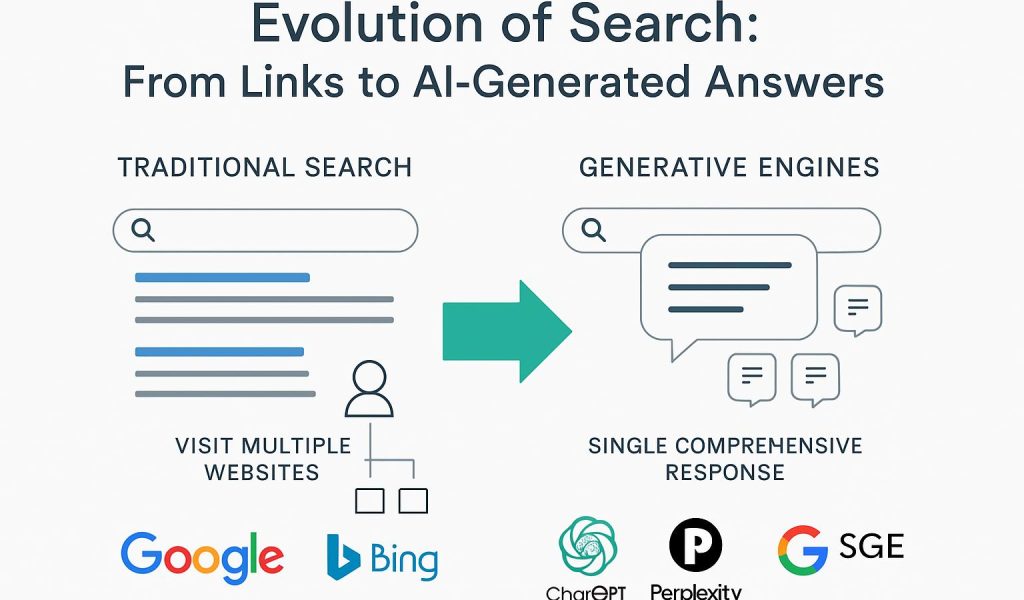
AI-powered search changes how people discover information.
Instead of reviewing a list of search results and opening several pages, users may receive a synthesized answer that summarizes information from multiple sources.
This creates two related opportunities for businesses:
A business can benefit from both. Organic rankings, AI citations, referral visits, and customer enquiries are different outcomes, so they should be measured separately.
For businesses investing in long-term organic growth, GEO is best approached as an extension of a well-developed SEO strategy.
AI search platforms use different retrieval, ranking, and generation processes. Some answers rely on information retrieved from the web, while other responses may use model knowledge or different combinations of sources.
In search-based AI experiences, the process can involve the following stages.
Google explains that its generative search experiences can use techniques such as retrieval-augmented generation and query fan-out to gather information relevant to a user’s question. These processes help explain why a single broad query may lead to several related searches.
Read Google’s official guide to optimizing for generative AI features in Search.
Important: These stages are a simplified explanation, not a universal description of every AI platform. ChatGPT Search, Google AI Overviews, and Perplexity do not necessarily select sources in identical ways.
This is why a successful GEO strategy should focus on strong fundamentals, relevant source credibility, and platform-specific measurement instead of relying on a single checklist of supposed ranking factors.
GEO and SEO overlap significantly, but their measurement objectives differ.
|
Factor |
Traditional SEO |
Generative Engine Optimization |
|
Main objective |
Improve visibility in organic search results |
Improve visibility in AI-generated responses |
|
Primary focus |
Search intent, content quality, technical SEO, and authority |
The same fundamentals, plus AI citations, brand mentions, and source visibility |
|
Platforms |
Google, Bing, and other search engines |
ChatGPT Search, Google AI features, Perplexity, and similar platforms |
|
Content strategy |
Answer search intent and satisfy users |
Answer user needs while making information clear, useful, and verifiable |
|
Authority building |
Relevant links, reputation, and other ranking signals |
Credible third-party coverage, relevant mentions, and source reputation |
|
Measurement |
Rankings, impressions, clicks, organic traffic, and conversions |
AI mentions, citations, referral visits, and attributable conversions |
The main distinction is not that SEO suddenly stops working. Google’s official guidance states that its AI search experiences rely on established Search ranking and quality systems.
For that reason, technical SEO, useful content, and a credible online presence remain important foundations for GEO.
Businesses should integrate AI search optimization into their existing search strategy rather than abandoning conventional SEO to chase an entirely separate set of supposed ranking factors.
An important research source is the September 2025 preprint Generative Engine Optimization: How to Dominate AI Search, by Mahe Chen, Xiaoxuan Wang, Kaiwen Chen, and Nick Koudas.
The authors compare AI-powered search with traditional web search and investigate differences in source selection, brand visibility, language, and query phrasing.
Their findings highlight several considerations for businesses:
These findings suggest that publishing useful information on your own website is important, but it should not be the only component of your strategy.
Read the original research: Generative Engine Optimization: How to Dominate AI Search.
The study has limitations. It represents a particular research design, time period, and set of observations. Its findings should not be interpreted as a definitive ranking formula for every current AI search platform.
The practical takeaway is to combine useful first-party content with genuine third-party credibility, then validate the approach against your own target queries and results.
High-quality content should be the foundation of your GEO strategy.
AI search systems can encounter substantial amounts of similar information. Publishing another article that repeats commonly available advice does not necessarily give your website a compelling reason to be referenced.
Instead, create content that adds something valuable.
For example, an SEO consultant writing about technical SEO could include:
This makes the content more useful to readers and provides specific information that other sources may not contain.
For your own website, consider documenting your SEO process, explaining decisions made during a real audit, and publishing evidence-backed case studies.
Explore the SEO services available for businesses in India to understand how technical improvements, content optimization, and authority building work together.
Answer-first content gives readers a clear response before introducing additional details.
Start each major section with a concise explanation of the question in its heading. Follow it with evidence, examples, qualifications, and practical instructions.
For example:
Question: How do I optimize my website for AI search?
Start by ensuring that important pages are crawlable and indexable, publish original and useful content, establish clear brand information, and earn relevant third-party coverage. Then monitor your visibility across the AI platforms that matter to your audience.
The remainder of the section can explain how to implement these steps.
Use this structure for relevant questions such as:
Direct answers can improve the usefulness of your content. However, there is no universal word count or answer format that guarantees an AI citation.
Clear information architecture helps readers locate relevant details and helps search systems process the content.
Use descriptive headings, focused paragraphs, useful lists, comparison tables, and relevant examples.
For example, an article about AI search optimization could use the following structure:
Use H3 headings to organize specific tactics within each main section.
Avoid adding unnecessary sections merely to increase article length. Every heading should help readers understand the subject or complete a task.
Google’s AI search optimization guidance recommends focusing on valuable content, clear technical structure, and the needs of your audience rather than trying to manipulate generative AI responses.
AI visibility starts with making your website accessible and understandable.
If important pages cannot be crawled, return errors, or are excluded from indexing, they may have difficulty appearing in search-based AI experiences.
Review the following technical elements:
For ChatGPT Search, OpenAI identifies OAI-SearchBot as a crawler used to help surface websites in search results. Review the official OpenAI crawler documentation and check your robots.txt file, hosting configuration, and CDN rules as applicable.
Do not assume that allowing a crawler guarantees inclusion. It addresses accessibility, not the final selection of sources.
If your website has indexing, rendering, or crawling problems, consider a technical SEO review before investing heavily in new content.
Your website is only one source of information about your business.
AI search experiences may encounter your brand through industry publications, reviews, directories, community discussions, professional profiles, and other relevant sources.
This makes credible off-page SEO and digital reputation important parts of a broader GEO strategy.
Practical activities include:
For example, an SEO consultant can demonstrate expertise through original case studies, useful technical guides, relevant editorial contributions, and a consistent professional presence.
Do not manufacture reviews, buy artificial mentions, or publish repetitive promotional comments to manipulate AI recommendations.
The objective is to establish a genuine reputation that people and information systems can verify. Third-party mentions can support that objective, but no specific volume of mentions guarantees AI visibility.
Structured data helps search engines interpret information about a page, business, person, article, or product.
Depending on your website, relevant schema types may include:
For example, an SEO consultant’s website may use accurate Person or Organization information, appropriate article markup, and relevant service information.
Ensure that the structured data reflects the actual page content, follows applicable guidelines, and passes validation.
Avoid adding unsupported claims, fabricated reviews, or misleading business information to schema.
Schema markup is not a guaranteed GEO ranking factor. Google’s official guidance states that special schema markup is not required for inclusion in AI Overviews or AI Mode.
Use structured data as part of a sound technical SEO strategy, not as a shortcut to AI citations.
A single article rarely covers every important question about a complex topic.
Develop a connected group of pages that explains the subject from different perspectives.
For a website focused on SEO services, a useful AI search content cluster could include:
Each article should serve a distinct search intent rather than repeat the same content with slightly different keywords.
Link these articles naturally to one another and to relevant service pages.
For example, a section explaining crawlability can link to your technical SEO services. A discussion about headings, page structure, and content relevance can link to your on-page SEO services.
Use descriptive anchor text that explains the destination. Avoid repeating the exact same commercial anchor in every paragraph.
Internal linking helps readers discover related information and provides a logical structure for search engines to follow.
Businesses should create content around the actual services, products, locations, and problems they serve.
A local service provider, for example, needs to explain where it operates, what it offers, and which customers it helps.
Useful local SEO activities include:
For a business serving Delhi NCR, location pages should provide meaningful information about the services available in the relevant area rather than simply replacing a city name across multiple pages.
For specialized industries, develop content that addresses the terminology, challenges, and decision-making criteria of the target audience.
This helps people understand the business and may improve its relevance for location-specific or industry-specific queries. AI recommendations remain dependent on the platform, query, and available sources.
E-E-A-T stands for Experience, Expertise, Authoritativeness, and Trustworthiness. Google uses these concepts within its quality evaluation framework, with trust being particularly important.
Although E-E-A-T is not a single measurable GEO ranking factor, the underlying principles are valuable for producing reliable content.
For each important article, consider including:
For example, an article about GEO should distinguish findings from an academic study from recommendations based on professional judgment.
If you publish an SEO case study, explain the website’s starting position, what was changed, the period measured, and which results can be verified.
Never invent experience, client results, testimonials, or research findings to make content appear more authoritative.
These practices improve reader confidence and help establish a credible website over time.
GEO should be measured through a repeatable process rather than occasional searches for your brand name.
Start by creating a list of relevant questions your customers might ask AI-powered platforms.
For example, an SEO consultant could track:
Test these questions across the platforms relevant to your business. Record whether your brand appears, whether your website is cited, which competing brands are mentioned, and which sources are referenced.
Repeat the tests using a consistent methodology. AI answers can change with query wording, location, time, and platform.
Alongside manual checks, monitor measurable website performance.
Metric | What it measures |
AI brand mentions | Whether your brand appears in relevant AI responses |
AI citations | Whether the platform links to your website |
Referral traffic | Visits attributed to AI search platforms |
Organic impressions and clicks | Performance in conventional search results |
Qualified enquiries | Potential customers contacting your business |
Conversions | Measurable actions that contribute to business goals |
Use Google Search Console for search performance and Google Analytics 4 for website traffic and conversions. Where available, review referral sources from AI platforms and use consistent attribution methods.
Do not assume that every AI mention can be measured in analytics. Many interactions happen without a click, and platforms provide different levels of reporting.
Your objective is to determine which activities improve relevant visibility and business outcomes, then prioritize those activities.
.
As AI search optimization becomes more popular, many recommendations are presented as essential even when there is little evidence to support them.
Avoid these common mistakes.
Traditional SEO remains important. Technical accessibility, relevant content, indexing, internal links, and site quality provide a foundation for search visibility.
An llms.txt file is not a requirement for appearing in Google’s generative AI search features. Google explicitly says special AI text files are not needed for inclusion in its Search experiences.
AI tools can assist with research and drafting, but mass-producing repetitive pages without meaningful value can create quality problems and may violate Google’s spam policies.
Use relevant terms naturally. Repeating GEO-related phrases excessively does not guarantee better rankings or more citations.
Focus on genuine third-party references, relevant editorial coverage, and useful contributions. Artificial mentions do not establish a trustworthy reputation.
There is no universal timeline for AI search visibility. Technical improvements, content updates, and authority-building activities can take time to influence discoverability and business results.
A brand mention can create awareness, but it does not automatically produce traffic or leads. Track citations alongside referral visits, enquiries, and conversions where possible.
For further guidance, consult Google’s official documentation on generative AI search optimization.
You can begin improving your website’s AI search readiness through a focused implementation plan.
Objective: Understand the current technical condition and visibility of your website.
Objective: Make existing content more useful, distinctive, and trustworthy.
Objective: Improve the quality and consistency of your online presence.
Objective: Establish a repeatable optimization and measurement process.
A 30-day plan is a starting point for implementation, not a guarantee of AI citations, rankings, or leads within that period.
Generative Engine Optimization is the process of improving a website's and brand's chances of being discovered, mentioned, or cited in AI-generated answers. It combines useful content, technical SEO, credibility, and ongoing visibility monitoring.
SEO focuses on improving visibility in organic search results and related search experiences. GEO places additional emphasis on whether AI-powered platforms reference or recommend your brand in generated responses. The two approaches overlap significantly, and traditional SEO remains important.
Make important pages accessible, publish original content, structure information clearly, strengthen your online reputation, and build relevant internal and external links. Then test relevant queries across AI search platforms and monitor citations, referral traffic, and conversions.
Start by ensuring that your important pages are publicly accessible and useful. Review the relevant OpenAI crawler settings, publish clear and credible information, and strengthen your presence on relevant third-party websites. These actions can improve discoverability but do not guarantee inclusion in an answer.
Structured data can help search engines interpret information about a page or business. However, Google does not require special schema markup for inclusion in AI Overviews or AI Mode. Use appropriate, accurate structured data as part of your broader SEO strategy.
No. Google states that special AI text files such as llms.txt are not necessary for inclusion in its generative AI search features. Do not prioritize this file over useful content, technical accessibility, and established SEO practices.
Follow Us:

Helping businesses scale their organic reach with data-driven SEO strategies, transparent reporting, and custom search optimization that converts clicks into loyal clients
+91 9540831302
info@freelanceseoservices.online
Yamuna Vihar, Delhi - 110053